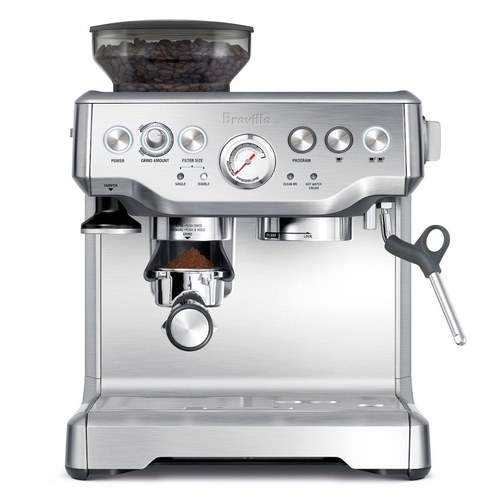
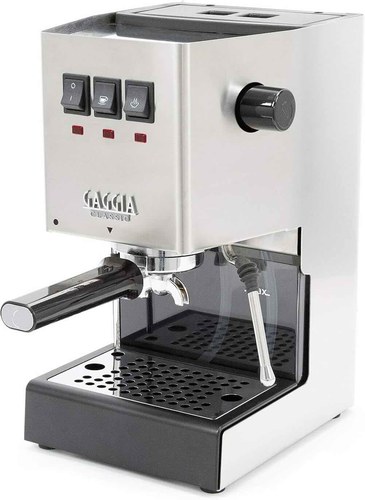
These aren't really the same category of purchase. The Barista Express is a complete grind-and-brew system. The Gaggia Classic Pro is a standalone machine that needs a separate grinder to actually work.
| Spec | Barista Express | Gaggia Classic Pro |
|---|---|---|
| Grinder | Built-in conical burr, dose control | Not included, requires a separate grinder |
| Portafilter | 54mm, 3-ear design | 58mm commercial-style, chrome-plated brass |
| Heating system | Thermocoil | Single boiler |
| Heat-up time | Reported anywhere from about 30 sec to several minutes* | Reported anywhere from about 2 to 10 minutes* |
| Pressure control | Standard pump | 3-way solenoid valve for a drier puck and cleaner release |
| Water tank | About 2 L | About 2 to 2.1 L |
| Construction | Mix of metal and plastic | Mostly metal, generally described as sturdier |
| Upgrade / mod potential | Limited, integrated design | Extensive, large aftermarket and mod community |
| Machine-only price | Higher, but includes the grinder | Lower, but a grinder still needs to be added |
No. The Gaggia Classic Pro is a standalone machine with no built-in grinder, so you need to budget for a separate burr grinder alongside it. The Barista Express includes a built-in grinder as part of the machine.
The Barista Express uses a 54mm portafilter, which is specific to Breville's mid-range machines. The Gaggia Classic Pro uses a commercial-standard 58mm portafilter, which opens up a much wider range of aftermarket baskets and accessories.
Sources vary quite a bit on both machines, but Thermocoil-based systems like the Barista Express's are generally reported as faster to a usable state than the Gaggia's single boiler, which several sources put in the 2 to 10 minute range depending on how it was measured.
The machine itself typically costs less, but that comparison isn't complete without adding a grinder, since the Gaggia doesn't include one. Once a decent grinder is factored in, the total cost of the two setups tends to land much closer together.
 Brew the Bean